How one Brooklyn house started the Dyker Heights lights
Nobody planned the Dyker Heights lights. The tour listings credit one homeowner on 84th Street, Lucy Spata, with starting it in the 1980s, and the street around her slowly followed. What follows is the story as far as it can be told without guessing, plus how it turned into a stop on bus tours from Manhattan.
One house on 84th Street
Ask a guide on the walk who started it and you will hear one name. The tour listings credit Lucy Spata, whose house on 84th Street lit up in the 1980s with far more than the usual wreath and string of bulbs.
Her display reportedly grew bigger every December. Figures appeared on the lawn and lights went up over every edge of the house. Soon people from other parts of Brooklyn were driving over to look.
Beyond that the details get hazy, and we would rather say less than repeat a legend. What is clear is that one house set a standard, and the street noticed.
A quiet neighborhood between two others
Dyker Heights sits in southwest Brooklyn, with Bay Ridge to the west and Bensonhurst to the east. For most of the year it is a calm residential place that few visitors to New York ever see.
Its streets are lined with detached houses, many of them set back behind front yards and driveways, which is unusual for Brooklyn. That space matters, because a lawn gives a family room for a nutcracker taller than the front door.
The neighborhood has a large Italian-American community, and Christmas has long been a big family occasion here. A tradition of decorating the house fits that background well, even before anyone thought of it as an attraction.
How one display became a friendly contest
Once one house glowed brighter than the rest, neighbors started to answer it. One family added a row of toy soldiers and the next put a Santa on the roof. Over the years the whole block raised its game.
Locals and guides tend to describe it as a friendly competition rather than a rivalry. Nobody hands out a prize, and the reward seems to be the crowd that stops in front of your gate.
Over time the effect took in a few blocks in the middle of the neighborhood. Our street-by-street guide to the brightest blocks shows which ones, and in what order to walk them.
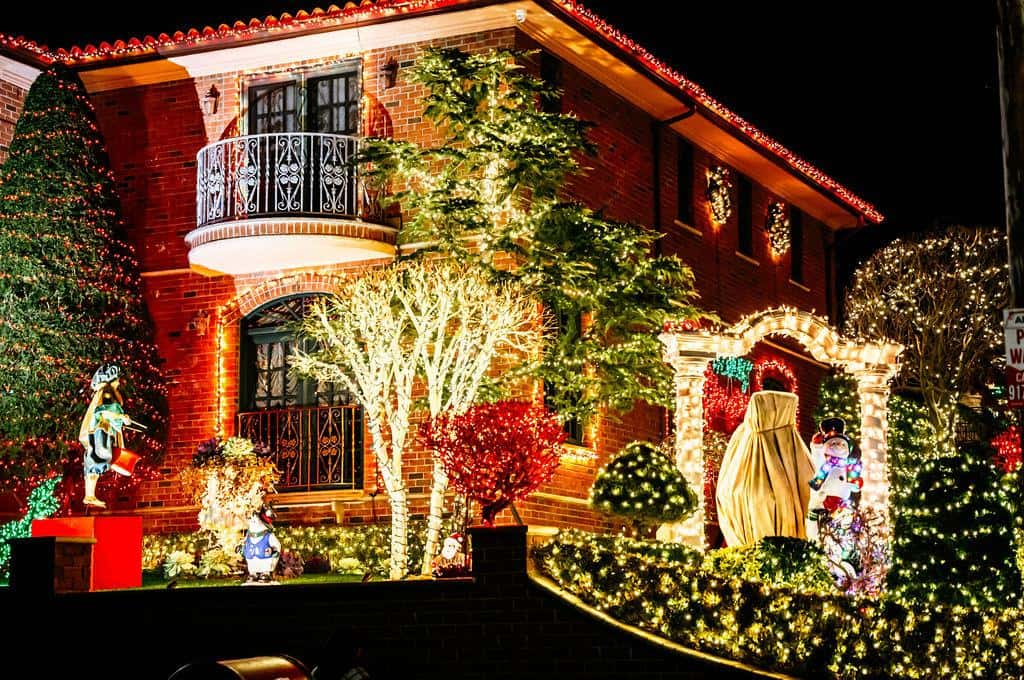
Professional crews and a big power bill
The biggest houses are no longer a weekend job with a ladder. Some homeowners reportedly hire professional decorating firms, who arrive in the weeks before Thanksgiving with trucks of figures and cable.
Every bulb runs on the homeowner's own meter. No city budget or sponsor covers the electricity, and residents have been quoted over the years describing seasonal bills far above a normal winter month.
A few houses put out a donation box or a sign about a charity. Giving is entirely up to you, and our page on visiting without annoying the neighbors covers how to behave on the pavement in front of them.
When the crowds started coming
Word of mouth came first. Newspapers and television picked up the story later. Over the following decades the lights went from a local drive-by to something visitors from abroad put on their New York list.
Tour companies followed the crowds. Because coaches can't fit into the narrow side streets, the bus tours that grew up around the lights all park nearby and walk their groups through the blocks on foot.
That shape still defines every tour on our site. Our guide to what a Dyker Heights lights tour costs sets the bus seats against a private limo for your own group, which trades the big coach for a car at your hotel door.
Hear the story on the street where it began
Scatto a New York's guides walk you past Lucy Spata's house and tell the history as you go, about an hour on foot, then a skyline stop on the way back.
No organizer, no ticket, no schedule
It surprises many visitors that nobody runs the event. No committee sets the dates and no office sells entry. The houses are private homes whose owners simply choose to decorate.
That is why the start date drifts a little from year to year and why one house may go dark while its neighbor stays bright. Most families switch on around Thanksgiving and keep going into early January.
Dates and hours get a guide of their own, down to the calmest weeknights. For the story itself, the takeaway is that every display depends on one household's goodwill.
A tour ticket pays for the ride and the guide, never for the lights. The residents receive nothing from the tour companies, which is one more reason to keep voices low and stay off the lawns.
Mixed feelings on the block
Not every resident loves the attention. Coaches idle on the avenues and parking vanishes. On busy Saturdays the pavements fill shoulder to shoulder until late.
Others clearly enjoy it, chatting to visitors from their porches and adding something new every December. Both views are fair, and reports from the neighborhood suggest most people sit somewhere between pride and fatigue.
Seeing the history with a guide
You can walk the blocks alone, as our guide to reaching Dyker Heights by subway explains. A guide adds the stories, though. They point out which houses started early and which joined later.
Our pick, Scatto a New York's lights bus from ~$63, walks the two most lit streets with Lucy Spata's house on the route. It holds 4.6 from 2,400+ reviews on GetYourGuide, the most of any Dyker Heights tour by a wide margin.
Midtown's windows can share the evening with the history too, and the two-borough route has its own page. Families should also read our notes on the Dyker Heights lights with kids before booking.